
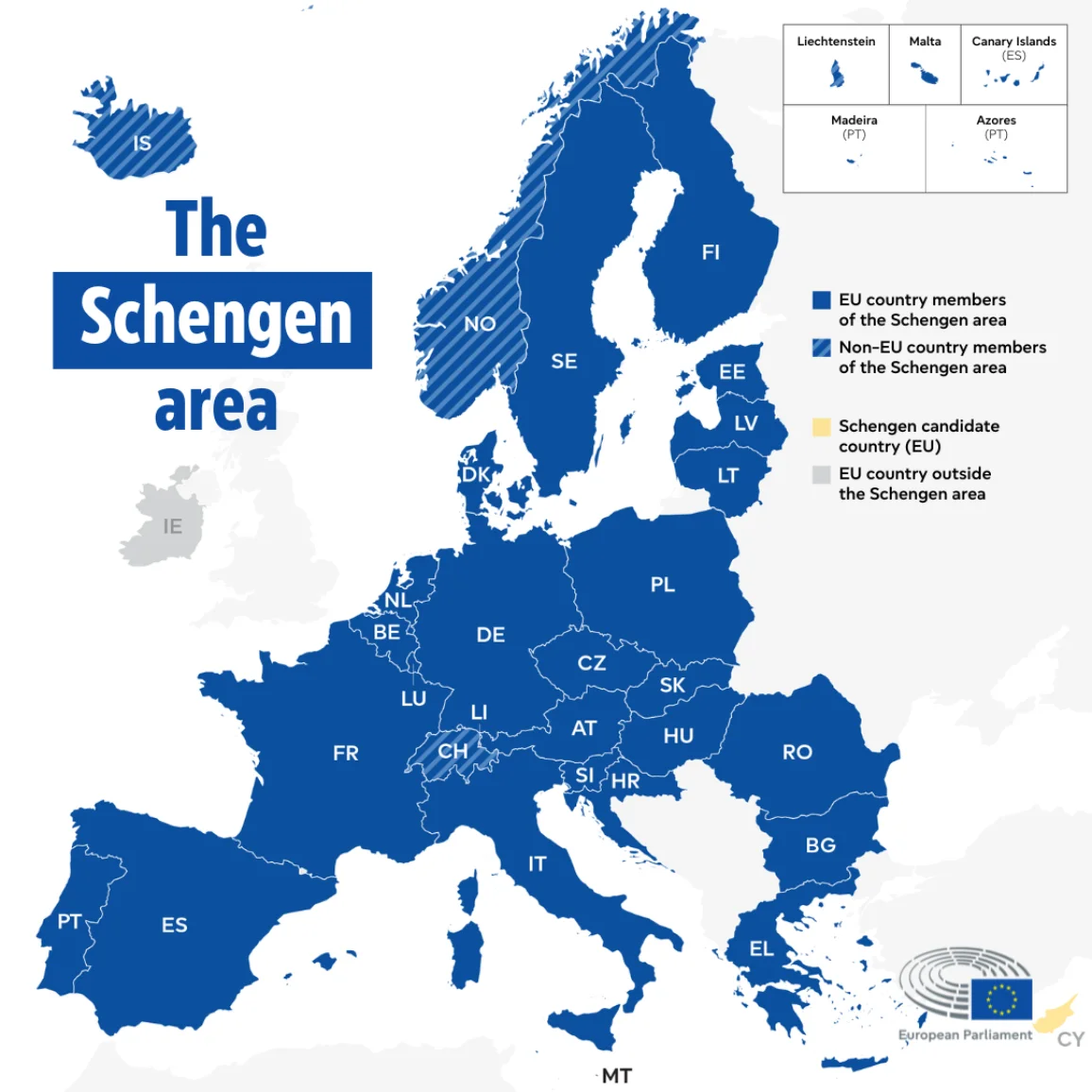
Spanish residency is frequently advertised alongside the phrase 'Schengen Zone access,' but the practical meaning of that phrase is worth spelling out clearly, since it's one of the more genuinely valuable side benefits of the move.
What the Schengen Zone actually is
The Schengen Zone is a group of European countries that have eliminated border checks between each other, allowing free movement across internal borders. It includes the large majority of EU countries plus a few non-EU members, and functions as a single area for the purposes of internal travel, even though each country remains a separate nation with its own laws and tax system.
What Spanish residency actually grants within it
Holding Spanish residency lets you travel freely across other Schengen countries without needing a separate visa for short stays, and generally without border checks at all when crossing internal Schengen borders. This is meaningfully different from the tourist visa rules that apply to non-residents, which limit total Schengen stays to 90 days within any 180-day period.
Why this matters beyond simple tourism
For Gulf-based professionals whose work or business involves travel across Europe, Schengen residency removes a layer of visa logistics that would otherwise apply on every trip. It also makes property viewing, school visits, and general lifestyle exploration across neighboring countries dramatically simpler during your transition period and afterward.
What it doesn't grant
Schengen access is about movement, not automatic work rights in every member country. Spanish residency lets you live and work in Spain specifically; working in another Schengen country generally still requires that country's own work authorization, even though you can travel there freely. This distinction trips people up — Schengen access and EU work rights are related but separate questions.
How this compares to a UAE-based starting point
UAE residents and citizens already enjoy strong visa-free or visa-on-arrival access to much of the world, so the Schengen benefit isn't primarily about ease of entry to Europe specifically — UAE passport holders typically already have reasonable access there. The more significant shift is the ability to actually live, work, and build a long-term life within the zone, not just visit it.
The path toward broader EU rights over time
Spanish residency, maintained and renewed over time, can form part of a longer path toward Spanish or EU citizenship for those who eventually want it, which would extend rights considerably further than Schengen travel access alone. This is a multi-year consideration, but worth knowing as the long-term trajectory rather than assuming residency is a fixed, unchanging status.
FAQ
Can I work remotely for my UAE employer while living in Spain under Schengen rules?
Yes, this is generally the basis of the remote-work visa category itself — Schengen rules govern movement, while your visa category governs your right to live and work from Spain specifically.
Do all EU countries belong to the Schengen Zone?
No — a few EU countries sit outside Schengen, and a few Schengen members aren't EU countries, so the two terms aren't interchangeable.
Want to understand exactly what residency unlocks for you?
We'll walk through what Spanish residency specifically means for your travel and work plans.
Check Your Eligibility →